The Operating System for Enterprise AI
One of the most telling moments I had over the last year was sitting in a Fortune 100 finance committee meeting where the CFO finally said the thing every CFO is thinking. He turned to the CTO and asked, in front of the board, "what had the company actually bought for the $87M it had spent on AI in the last eighteen months."
The CTO had a list of pilots, an AI Center of Excellence, a vendor portfolio, two cloud commitments, and three new hires with the word "AI" in their titles. He did not have a list of decisions the AI program had improved, dollars it had moved, or customer outcomes that would not have happened without it. The room got quiet.
The diagnosis everyone agrees on
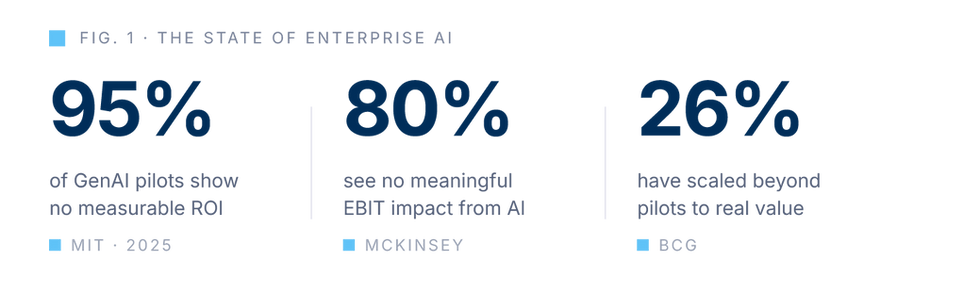
The diagnosis is not in dispute. Most enterprise AI programs are stuck. McKinsey says 80% of companies see no meaningful EBIT impact. BCG says only 26% have moved beyond pilots to scaled value. MIT says 95% of GenAI pilots show no measurable ROI. Take whichever number you prefer. The story is the same. We are sitting on tens of billions of dollars of AI spend and a board-level demand for measurable returns.
Diagnoses outnumber prescriptions. There is no shortage of explanations: data is not ready, talent is scarce, change management is hard, governance is immature, the technology is moving too fast to commit, the technology is not yet good enough to commit, and so on. All of those things are partly true. None of them is the actual reason.
The actual reason is that most enterprises do not have an operating system for AI. They have a strategy deck, a platform team, a pilot portfolio, and a Center of Excellence. What they do not have is the decision-making cadence that connects the strategy to the pilots, the pilots to the platform, and the platform to the P&L. Without that operating system, AI investment compounds slowly or not at all, and the CFO's question never has a satisfying answer.
The sequence that actually works
The enterprises that are getting AI to compound are not doing more pilots. They are doing fewer, in a specific sequence, with specific governance, and with the CFO co-signing the KPIs. The sequence has three pieces. Selection: choose one lighthouse use case, not fifty pilots. Sequence: let that use case force the governance and operating model, not the other way around. Operating discipline: build the value realization process that survives the next downturn and the next leadership change. This is not a methodology. It is the pattern I see in the work that produces measurable results. The companies that follow it tend to have one thing in common. They have stopped treating AI as a technology problem and started treating it as a strategy, operations, and value realization problem that happens to involve technology.

Three components of an operating system that works
The operating system has three components. Each one is necessary. None of them is sufficient on its own. Each cycle makes the next selection easier and the governance more politically possible.

Selection
One lighthouse use case, not fifty pilots. The lighthouse use case is the one that, if it works, the CFO will sign the KPIs for and the board will fund the operating model around. It is chosen based on three criteria: measurable value within the planning cycle, organizational willingness to change the way work gets done, and proximity to the company's actual competitive advantage. Most enterprises have at least one. Most enterprises also have forty-nine pilots that are not it.

Sequence
Sequence. The use case forces the governance, not the other way around. A lighthouse use case in customer service forces specific decisions about data, integration, agent oversight, escalation paths, and quality measurement. A lighthouse use case in underwriting forces different decisions. The governance and operating model emerge from the use case. Designing the governance first and then looking for use cases that fit it produces what most enterprises currently have, which is governance that no one uses.

Operating discipline
Operating discipline. Value realization, not uptime, is what survives the next downturn. The discipline includes monthly business reviews tied to the lighthouse KPIs, named owners on the business side rather than the technology side, and the willingness to kill the use case if it does not produce results by the end of the planning cycle. Companies that build this discipline find that the second use case is easier to launch than the first, and the third is easier than the second. Companies that do not build it find that the second use case has the same problems as the first.

What this means for the question you are asking
If you are a CEO or business unit president asking whether your AI program is producing returns, the operating system is what you do not yet have. The pilots, the platform, and the Center of Excellence are inputs, not the system. The question to ask is which one or two use cases you would treat as lighthouse, what governance that would force, and whether your CFO would sign the KPIs.
If you are a CTO, CIO, or chief AI officer trying to convert AI strategy into measurable results, the operating system is the work that turns the artifacts into a cadence. The deck and the platform are necessary. They are not sufficient. The cadence is what compounds.
If you are an investor evaluating a target's AI capability, the operating system is what to look for in diligence. Strategy decks are easy. Operating discipline is hard. Companies that have built the operating discipline are worth more than companies that have built the deck.
The Operating System for Enterprise AI is not a methodology I sell. It is a pattern I have seen produce results across services firms, software companies, enterprises, and PE portfolios. The three articles linked below take the three components apart in more depth. If you are wrestling with a specific decision in this space, that is where my work tends to start.

ARC ONE
The Operating System for Enterprise AI
Three pieces on the program-level discipline that determines whether enterprise AI delivers value or gets cut. Selection, Sequence, and Operating Discipline as the components of an AI program that survives.
ARC Two
Operating AI in Production
What it actually takes to build the second kind of AI. The architectural pattern and the production requirements that separate operating systems from collections of point solutions.
Architecture
Most enterprises are deploying AI as point solutions when they should be running it as an operating system for the business. The architectural distinction between automation and operation, the six properties that make operating AI production-ready, and four diagnostic questions for any enterprise AI program in your portfolio.
Scaling
With models commoditized and the architecture buildable by anyone with discipline, the durable advantage is the operating model that lets you scale AI in a federated way without losing coherence. The four components that make it work, the two ways enterprises destroy it, and three diagnostic questions that tell you whether you are building a durable advantage or a collection of deployments
Implementation
The gap between a demo that works and a system that operates is architectural, and it is the gap most enterprise AI programs will not cross. The three layers that produce operating AI, the three failure modes that stall it (the Chain Trap, Agent Theater, and the Invisible Layer), and five diagnostic questions for any AI deployment in your portfolio.
Governance
Once agents hold real access and take real action, governance stops being a launch gate and becomes a continuous discipline. Why an agent is an actor rather than a tool, the four controls that keep a fleet of agents honest, and three questions that tell whether you govern your agents or merely run them.
The Buyer's Lens
Reading the Series From the Other Side of the Table
Seven pieces argued durable AI advantage from inside the enterprise. This one turns the camera around and asks what a buyer should pay for, and what any operator should be able to answer before someone outside the building asks.